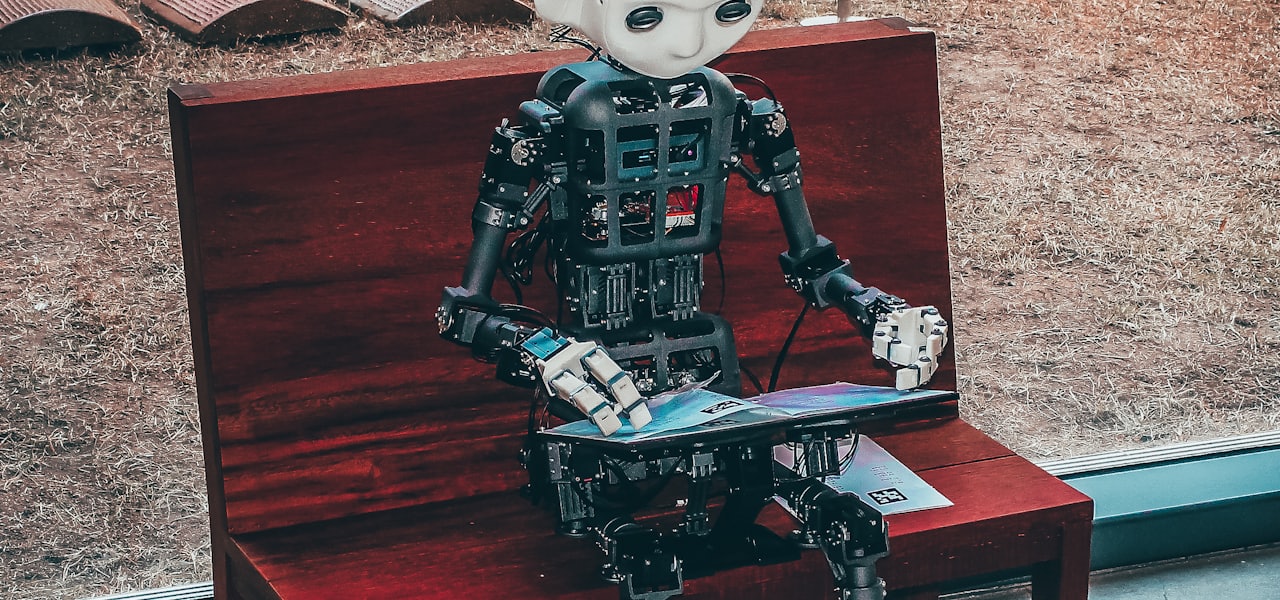
Quantum robotics is an interdisciplinary field that investigates the intersection of robotics and quantum mechanics. This field, in particular, explores the applications of quantum phenomena such as quantum entanglement within the realm of robotics. Examples of its applications include quantum communication in multi-agent cooperative robotic scenarios, the use of quantum algorithms in performing robotics tasks, and the integration of quantum devices (e.g., quantum detectors) in robotic systems. == Introduction == The free-space quantum communication between mobile platforms was proposed for reconfigurable quantum key distribution (QKD) applications using unmanned aerial vehicle (UAVs, a.k.a. drones) in 2017. This technology was later advanced in various aspects in mobile drone and vehicle platforms in several configurations such as drone-to-drone, drone-to-moving vehicle, and vehicle-to-vehicle systems. Some research has contributed to low-size, low-weight, and low-power quantum key distribution systems for small-form UAVs, the characterization of a polarization-based receiver for mobile free-space optical QKD, and optical-relayed entanglement distribution using drones as mobile nodes. The topic of free-space quantum communication between mobile platforms, initially developed to meet the need for free-space QKD and entanglement distribution using mobile nodes, was brought into the robotics domain as an emerging interdisciplinary mechatronics topic to investigate the interface between quantum technologies and the robotic systems domain. The main advantage of such integrated technology is the guaranteed security in communication between multi-agent and cooperative autonomous systems. Other advances are anticipated. == Quantum entanglement == According to quantum mechanics, entanglement occurs when more than one particle become connected. If the state of one particle changes then it will instantly change the state of other particles regardless of their distance. Entangled sensors do the same kind of work and achieve strong sensitivity. A group of quantum robots can measure magnetic fields, gravitational fields and other physical properties using entangled sensors with high rate of accuracy. Again the connection of one robot to other is increased (become strong) by quantum entanglement. == Quantum teleportation == Quantum teleportation is the transfer of quantum information (not physical objects). This is used in case of multi robot process. One robot is programmed with a complex quantum update. Then that robot can teleport that complex quantum information (the update) to other robots. This teleportation or communication is very secure because all the work is done in quantum state. == Kinematics == Quantum computing has been proposed as being optimal for calculating inverse kinematics values. == Alice and Bob robots == In the realm of quantum mechanics, the names Alice and Bob are frequently employed to illustrate various phenomena, protocols, and applications. These include their roles in QKD, quantum cryptography, entanglement, and teleportation. The terms "Alice Robot" and "Bob Robot" serve as analogous expressions that merge the concepts of Alice and Bob from quantum mechanics with mechatronic mobile platforms (such as robots, drones, and autonomous vehicles). For example, the Alice Robot functions as a transmitter platform that communicates with the Bob Robot, housing the receiving detectors.
EM algorithm and GMM model
In statistics, EM (expectation maximization) algorithm handles latent variables, while GMM is the Gaussian mixture model. == Background == In the picture below, are shown the red blood cell hemoglobin concentration and the red blood cell volume data of two groups of people, the Anemia group and the control group (i.e. the group of people without Anemia). As expected, people with Anemia have lower red blood cell volume and lower red blood cell hemoglobin concentration than those without Anemia. x {\displaystyle x} is a random vector such as x := ( red blood cell volume , red blood cell hemoglobin concentration ) {\displaystyle x:={\big (}{\text{red blood cell volume}},{\text{red blood cell hemoglobin concentration}}{\big )}} , and from medical studies it is known that x {\displaystyle x} are normally distributed in each group, i.e. x ∼ N ( μ , Σ ) {\displaystyle x\sim {\mathcal {N}}(\mu ,\Sigma )} . z {\displaystyle z} is denoted as the group where x {\displaystyle x} belongs, with z i = 0 {\displaystyle z_{i}=0} when x i {\displaystyle x_{i}} belongs to the Anemia group and z i = 1 {\displaystyle z_{i}=1} when x i {\displaystyle x_{i}} belongs to the control group. Also z ∼ Categorical ( k , ϕ ) {\displaystyle z\sim \operatorname {Categorical} (k,\phi )} where k = 2 {\displaystyle k=2} , ϕ j ≥ 0 , {\displaystyle \phi _{j}\geq 0,} and ∑ j = 1 k ϕ j = 1 {\displaystyle \sum _{j=1}^{k}\phi _{j}=1} . See Categorical distribution. The following procedure can be used to estimate ϕ , μ , Σ {\displaystyle \phi ,\mu ,\Sigma } . A maximum likelihood estimation can be applied: ℓ ( ϕ , μ , Σ ) = ∑ i = 1 m log ( p ( x ( i ) ; ϕ , μ , Σ ) ) = ∑ i = 1 m log ∑ z ( i ) = 1 k p ( x ( i ) ∣ z ( i ) ; μ , Σ ) p ( z ( i ) ; ϕ ) {\displaystyle \ell (\phi ,\mu ,\Sigma )=\sum _{i=1}^{m}\log(p(x^{(i)};\phi ,\mu ,\Sigma ))=\sum _{i=1}^{m}\log \sum _{z^{(i)}=1}^{k}p\left(x^{(i)}\mid z^{(i)};\mu ,\Sigma \right)p(z^{(i)};\phi )} As the z i {\displaystyle z_{i}} for each x i {\displaystyle x_{i}} are known, the log likelihood function can be simplified as below: ℓ ( ϕ , μ , Σ ) = ∑ i = 1 m log p ( x ( i ) ∣ z ( i ) ; μ , Σ ) + log p ( z ( i ) ; ϕ ) {\displaystyle \ell (\phi ,\mu ,\Sigma )=\sum _{i=1}^{m}\log p\left(x^{(i)}\mid z^{(i)};\mu ,\Sigma \right)+\log p\left(z^{(i)};\phi \right)} Now the likelihood function can be maximized by making partial derivative over μ , Σ , ϕ {\displaystyle \mu ,\Sigma ,\phi } , obtaining: ϕ j = 1 m ∑ i = 1 m 1 { z ( i ) = j } {\displaystyle \phi _{j}={\frac {1}{m}}\sum _{i=1}^{m}1\{z^{(i)}=j\}} μ j = ∑ i = 1 m 1 { z ( i ) = j } x ( i ) ∑ i = 1 m 1 { z ( i ) = j } {\displaystyle \mu _{j}={\frac {\sum _{i=1}^{m}1\{z^{(i)}=j\}x^{(i)}}{\sum _{i=1}^{m}1\left\{z^{(i)}=j\right\}}}} Σ j = ∑ i = 1 m 1 { z ( i ) = j } ( x ( i ) − μ j ) ( x ( i ) − μ j ) T ∑ i = 1 m 1 { z ( i ) = j } {\displaystyle \Sigma _{j}={\frac {\sum _{i=1}^{m}1\{z^{(i)}=j\}(x^{(i)}-\mu _{j})(x^{(i)}-\mu _{j})^{T}}{\sum _{i=1}^{m}1\{z^{(i)}=j\}}}} If z i {\displaystyle z_{i}} is known, the estimation of the parameters results to be quite simple with maximum likelihood estimation. But if z i {\displaystyle z_{i}} is unknown it is much more complicated. Being z {\displaystyle z} a latent variable (i.e. not observed), with unlabeled scenario, the expectation maximization algorithm is needed to estimate z {\displaystyle z} as well as other parameters. Generally, this problem is set as a GMM since the data in each group is normally distributed. In machine learning, the latent variable z {\displaystyle z} is considered as a latent pattern lying under the data, which the observer is not able to see very directly. x i {\displaystyle x_{i}} is the known data, while ϕ , μ , Σ {\displaystyle \phi ,\mu ,\Sigma } are the parameter of the model. With the EM algorithm, some underlying pattern z {\displaystyle z} in the data x i {\displaystyle x_{i}} can be found, along with the estimation of the parameters. The wide application of this circumstance in machine learning is what makes EM algorithm so important. == EM algorithm in GMM == The EM algorithm consists of two steps: the E-step and the M-step. Firstly, the model parameters and the z ( i ) {\displaystyle z^{(i)}} can be randomly initialized. In the E-step, the algorithm tries to guess the value of z ( i ) {\displaystyle z^{(i)}} based on the parameters, while in the M-step, the algorithm updates the value of the model parameters based on the guess of z ( i ) {\displaystyle z^{(i)}} of the E-step. These two steps are repeated until convergence is reached. The algorithm in GMM is: Repeat until convergence: 1. (E-step) For each i , j {\displaystyle i,j} , set w j ( i ) := p ( z ( i ) = j | x ( i ) ; ϕ , μ , Σ ) {\displaystyle w_{j}^{(i)}:=p\left(z^{(i)}=j|x^{(i)};\phi ,\mu ,\Sigma \right)} 2. (M-step) Update the parameters ϕ j := 1 m ∑ i = 1 m w j ( i ) {\displaystyle \phi _{j}:={\frac {1}{m}}\sum _{i=1}^{m}w_{j}^{(i)}} μ j := ∑ i = 1 m w j ( i ) x ( i ) ∑ i = 1 m w j ( i ) {\displaystyle \mu _{j}:={\frac {\sum _{i=1}^{m}w_{j}^{(i)}x^{(i)}}{\sum _{i=1}^{m}w_{j}^{(i)}}}} Σ j := ∑ i = 1 m w j ( i ) ( x ( i ) − μ j ) ( x ( i ) − μ j ) T ∑ i = 1 m w j ( i ) {\displaystyle \Sigma _{j}:={\frac {\sum _{i=1}^{m}w_{j}^{(i)}\left(x^{(i)}-\mu _{j}\right)\left(x^{(i)}-\mu _{j}\right)^{T}}{\sum _{i=1}^{m}w_{j}^{(i)}}}} With Bayes' rule, the following result is obtained by the E-step: p ( z ( i ) = j | x ( i ) ; ϕ , μ , Σ ) = p ( x ( i ) | z ( i ) = j ; μ , Σ ) p ( z ( i ) = j ; ϕ ) ∑ l = 1 k p ( x ( i ) | z ( i ) = l ; μ , Σ ) p ( z ( i ) = l ; ϕ ) {\displaystyle p\left(z^{(i)}=j|x^{(i)};\phi ,\mu ,\Sigma \right)={\frac {p\left(x^{(i)}|z^{(i)}=j;\mu ,\Sigma \right)p\left(z^{(i)}=j;\phi \right)}{\sum _{l=1}^{k}p\left(x^{(i)}|z^{(i)}=l;\mu ,\Sigma \right)p\left(z^{(i)}=l;\phi \right)}}} According to GMM setting, these following formulas are obtained: p ( x ( i ) | z ( i ) = j ; μ , Σ ) = 1 ( 2 π ) n / 2 | Σ j | 1 / 2 exp ( − 1 2 ( x ( i ) − μ j ) T Σ j − 1 ( x ( i ) − μ j ) ) {\displaystyle p\left(x^{(i)}|z^{(i)}=j;\mu ,\Sigma \right)={\frac {1}{(2\pi )^{n/2}\left|\Sigma _{j}\right|^{1/2}}}\exp \left(-{\frac {1}{2}}\left(x^{(i)}-\mu _{j}\right)^{T}\Sigma _{j}^{-1}\left(x^{(i)}-\mu _{j}\right)\right)} p ( z ( i ) = j ; ϕ ) = ϕ j {\displaystyle p\left(z^{(i)}=j;\phi \right)=\phi _{j}} In this way, a switch between the E-step and the M-step is possible, according to the randomly initialized parameters.
Graphics address remapping table
The graphics address remapping table (GART), also known as the graphics aperture remapping table, or graphics translation table (GTT), is an I/O memory management unit (IOMMU) used by Accelerated Graphics Port (AGP) and PCI Express (PCIe) graphics cards. The GART allows the graphics card direct memory access (DMA) to the host system memory, through which buffers of textures, polygon meshes and other data are loaded. AMD later reused the same mechanism for I/O virtualization with other peripherals including disk controllers and network adapters. A GART is used as a means of data exchange between the main memory and video memory through which buffers (i.e. paging/swapping) of textures, polygon meshes and other data are loaded, but can also be used to expand the amount of video memory available for systems with only integrated or shared graphics (i.e. no discrete or inbuilt graphics processor), such as Intel HD Graphics processors. However, this type of memory (expansion) remapping has a caveat that affects the entire system: specifically, any GART, pre-allocated memory becomes pooled and cannot be utilised for any other purposes but graphics memory and display rendering. Since PCI Express, the GART is extended to the GTT (Graphics Translation Table), which act as a buffer or cache between system memory and graphics card, and in PCI Express, the GTT buffer size is changeable by the GPU driver. == Operating system support == === Windows === Support for AGP GART was added since Windows 95 OSR2. Later, support for GTT was added since Windows XP SP2 and Windows Vista. === Linux === Jeff Hartmann served as the primary maintainer of the Linux kernel's agpgart driver, which began as part of Brian Paul's Utah GLX accelerated Mesa 3D driver project. The developers primarily targeted Linux 2.4.x kernels, but made patches available against older 2.2.x kernels. Dave Jones heavily reworked agpgart for the Linux 2.6.x kernels, along with more contributions from Jeff Hartmann. === FreeBSD === In FreeBSD, the agpgart driver appeared in its 4.1 release. === Solaris === AGPgart support was introduced into Solaris Express Developer Edition as of its 7/05 release.
Drop shadow
In graphic design and computer graphics, a drop shadow is a visual effect consisting of a drawing element which looks like the shadow of an object, giving the impression that the object is raised above the objects behind it. The drop shadow is often used for elements of a graphical user interface such as windows or menus, and for simple text. The text label for icons on desktops in many desktop environments has a drop shadow, as this effect effectively distinguishes the text from any colored background it may be in front of. A simple way of drawing a drop shadow of a rectangular object is to draw a gray or black area underneath and offset from the object. In general, a drop shadow is a copy in black or gray of the object, drawn in a slightly different position. Realism may be increased by: Darkening the colors of the pixels where the shadow casts instead of making them gray. This can be done with alpha blending the shadow with the area it is cast on. Softening the edges of the shadow. This can be done by adding Gaussian blur to the shadow's alpha channel before blending. Inset drop shadows are a type which draws the shadows inside the element. This allows the interface element to appear as if it is sunken into the interface. == Photo editing == In photo editing or photography post-production, a drop shadow may be added right beneath a model or product in the image. It is used to create contrast between the background and the subject. To add a drop shadow, retouchers use graphic editing tools like Adobe Photoshop. Drop shadows are often used as a visual effect in e-commerce. This is done to improve the presentation of product images and create depth in the image. == Use == Generally, window managers which are capable of compositing allow drop shadow effects, whereas incapable window managers do not. In some operating systems like macOS, drop shadow is used to differentiate between active and inactive windows. Websites are able to use drop shadow effects through the CSS properties box-shadow, text-shadow, and drop-shadow() filter function in filter. The first two are used for elements and text respectively, while the filter applies to the element's content, letting it support oddly shaped elements or transparent images.
DUAL table
The DUAL table is a special one-row, one-column table present by default in Oracle and other database installations. In Oracle, the table has a single VARCHAR2(1) column called DUMMY that has a value of 'X'. It is suitable for use in selecting a pseudo column such as SYSDATE or USER. == Example use == Oracle's SQL syntax requires the FROM clause but some queries don't require any tables - DUAL can be used in these cases. == History == Charles Weiss explains why he created DUAL: I created the DUAL table as an underlying object in the Oracle Data Dictionary. It was never meant to be seen itself, but instead used inside a view that was expected to be queried. The idea was that you could do a JOIN to the DUAL table and create two rows in the result for every one row in your table. Then, by using GROUP BY, the resulting join could be summarized to show the amount of storage for the DATA extent and for the INDEX extent(s). The name, DUAL, seemed apt for the process of creating a pair of rows from just one. == Optimization == Beginning with 10g Release 1, Oracle no longer performs physical or logical I/O on the DUAL table, though the table still exists. DUAL is readily available for all authorized users in a SQL database. == In other database systems == Several other databases (including Microsoft SQL Server, MySQL, PostgreSQL, SQLite, and Teradata) enable one to omit the FROM clause entirely if no table is needed. This avoids the need for any dummy table. ClickHouse has a one-row system table system.one with a single column named "dummy" of type UInt8 and value 0. This table is implicitly used when no table is specified in the SELECT query. Firebird has a one-row system table RDB$DATABASE that is used in the same way as Oracle's DUAL, although it also has a meaning of its own. IBM Db2 has a view that resolves DUAL when using Oracle Compatibility. It also has a table called sysibm.sysdummy1 that has similar properties to the Oracle DUAL one. Informix: Informix version 11.50 and later has a table named sysmaster:"informix".sysdual with the same functionality but a more verbose name. You can use CREATE PUBLIC SYNONYM dual FOR sysmaster:"informix".sysdual to create a name dual in the current database with the same functionality. Microsoft Access: A table named DUAL may be created and the single-row constraint enforced via ADO (Table-less UNION query in MS Access) Microsoft SQL Server: SQL Server does not require a dummy table. Queries like 'select 1 + 1' can be run without a "from" clause/table name. MySQL allows DUAL to be specified as a table in queries that do not need data from any tables. It is suitable for use in selecting a result function such as SYSDATE() or USER(), although it is not essential. PostgreSQL: A DUAL-view can be added to ease porting from Oracle. Snowflake: DUAL is supported, but not explicitly documented. It appears in sample SQL for other operations in the documentation. SQLite: A VIEW named "dual" that works the same as the Oracle "dual" table can be created as follows: CREATE VIEW dual AS SELECT 'x' AS dummy; SAP HANA has a table called DUMMY that works the same as the Oracle "dual" table. Teradata database does not require a dummy table. Queries like 'select 1 + 1' can be run without a "from" clause/table name. Vertica has support for a DUAL table in their official documentation.
List of data science software
This is a list of data science software and platforms used in data science, which includes programming languages, programming environments, machine learning frameworks, data engineering tools, statistical software, data analysis, plotting, MLOps systems, and more. == Programming languages == == Development environments == These interactive notebooks, IDEs, and platforms provide specialised development environments. Apache Zeppelin Architect — Eclipse (software) CoCalc Dataiku Data Science Studio FreeMat GNU Octave Google Colab DataSpell Jupyter Notebook / JupyterLab Kaggle Notebooks MATLAB O-Matrix PyCharm RStudio SAS (software) and SAS Studio Spyder Visual Studio Code == Machine and deep learning software == The Machine learning / deep learning tools support development in those fields. == Data engineering == Examples of Data engineering tools. Apache Airflow Apache Flink Apache Hadoop Apache Kafka Apache NiFi Apache Spark Dask Data build tool (dbt) == Data mining == Examples of Data mining tools. === Free and open-source === === Proprietary === == Database management == === List of RDBMS === ==== Proprietary ==== == Data warehouses == Data warehouse environments include: Amazon Redshift Snowflake Google BigQuery Microsoft Azure Synapse Teradata Vertica == Data lakes == Data lake environments include: Apache Hadoop Cloudera Databricks Delta Lake Amazon S3 Google Cloud Storage Azure Data Lake == Algorithms == Apriori algorithm – frequent itemset mining and association rule learning in market basket analysis Backpropagation – algorithm for training artificial neural networks using gradient descent Decision Trees – tree-based algorithm for classification and regression Expectation–maximization algorithm – iterative procedure for maximum likelihood estimation with latent variables Gradient descent – iterative optimization algorithm for minimizing a loss function ID3 algorithm – used to generate a decision tree from a dataset K-Means – clustering algorithm based on minimizing within-cluster distances K-Nearest Neighbors (KNN) – instance-based learning and classification method Linear regression – estimation method for predicting a dependent variable based on independent variables Logistic regression – classification algorithm for predicting a binary outcome Naive Bayes – probabilistic classifier based on Bayes' theorem Ordinary least squares – estimation method for parameters in linear regression PageRank – graph-based algorithm for link analysis and search ranking Principal component analysis – technique to reduce high-dimensional data while preserving variance Q-learning – reinforcement learning algorithm for learning optimal actions Random forest – ensemble of decision trees for improved classification or regression Sequential minimal optimization – solver for training support vector machines Stochastic gradient descent – randomized variant of gradient descent for large-scale machine learning Support Vector Machines (SVM) – algorithm for finding a hyperplane to separate classes == Statistical software == === Open-source === === Public domain === CSPro Dataplot Epi Map X-13ARIMA-SEATS === Freeware === BV4.1 MINUIT WinBUGS Winpepi === Proprietary === == Data processing == Tools for Data processing and analysis: == Data and information visualization == Software for Data visualization: == Plotting software == Software for plotting data to support processing and visualise results. == Maps and geospatial visualization == ArcGIS Carto Epi Map GeoDA Google Earth Engine Leaflet Mapbox MountainsMap QGIS == Machine learning == MLOps and model deployment: BentoML Data Version Control (DVC) Kubeflow MLflow Seldon Core Streamlit TensorFlow Serving Weights & Biases == Data repositories == Kaggle – platform for data science competitions, datasets, and notebooks. OpenML – collaborative platform for sharing datasets, algorithms, and experiments. University of California, Irvine Machine Learning Repository Zenodo – open-access repository supported by CERN and the EU. == Educational data science software == Kaggle – online platform for data science education, competitions, datasets, and collaborative learning. KNIME – open-source data analytics platform used for teaching data science, machine learning, and workflow-based analysis. RapidMiner – used in academic research and education for data mining and machine learning. Statistics Online Computational Resource (SOCR) – online tools and instructional resources for statistics education. Tanagra (machine learning) – data mining software developed for research and teaching purposes. TinkerPlots – explore and analyze data through visual modeling.
Shell Control Box
Shell Control Box (SCB) is a network security appliance that controls privileged access to remote IT systems, records activities in replayable audit trails, and prevents malicious actions. For example, it records as a system administrator updates a file server or a third-party network operator configures a router. The recorded audit trails can be replayed like a movie to review the events as they occurred. The content of the audit trails is indexed to make searching for events and automatic reporting possible. SCB is a Linux-based device developed by Balabit. It is an application level proxy gateway. In 2017, Balabit changed the name of the product to Privileged Session Management (PSM) and repositioned it as the core module of its Privileged Access Management solution. == Main Features == Balabit’s Privileged Session Management (PSM), Shell Control Box (SCB) is a device that controls, monitors, and audits remote administrative access to servers and network devices. It is a tool to oversee system administrators by controlling the encrypted connections used for administration. PSM (SCB) has full control over the SSH, RDP, Telnet, TN3270, TN5250, Citrix ICA, and VNC connections, providing a framework (with solid boundaries) for the work of the administrators. === Gateway Authentication === PSM (SCB) acts as an authentication gateway, enforcing strong authentication before users access IT assets. PSM can also integrate to user directories (for example, a Microsoft Active Directory) to resolve the group memberships of the users who access the protected servers. Credentials for accessing the server are retrieved transparently from PSM’s credential store or a third-party password management system by PSM impersonating the authenticated user. This automatic password retrieval protects the confidentiality of passwords as users can never access them. === Access Control === PSM controls and audits privileged access over the most wide-spread protocols such as SSH, RDP, or HTTP(s). The detailed access management helps to control who can access what and when on servers. It is also possible to control advanced features of the protocols, like the type of channels permitted. For example, unneeded channels like file transfer or file sharing can be disabled, reducing the security risk on the server. With PSM policies for privileged access can be enforced in one single system. === 4-eyes Authorization === To avoid accidental misconfiguration and other human errors, PSM supports the 4-eyes authorization principle. This is achieved by requiring an authorizer to allow administrators to access the server. The authorizer also has the possibility to monitor – and terminate - the session of the administrator in real-time, as if they were watching the same screen. === Real-time Monitoring and Session Termination === PSM can monitor the network traffic in real time, and execute various actions if a certain pattern (for example, a suspicious command, window title or text) appears on the screen. PSM can also detect specific patterns such as credit card numbers. In case of detecting a suspicious user action, PSM can send an e-mail alert or immediately terminate the connection. For example, PSM can block the connection before a destructive administrator command, such as the „rm” comes into effect. === Session Recording === PSM makes user activities traceable by recording them in tamper-proof and confidential audit trails. It records the selected sessions into encrypted, timestamped, and digitally signed audit trails. Audit trails can be browsed online, or followed real-time to monitor the activities of the users. PSM replays the recorded sessions just like a movie – actions of the users can be seen exactly as they appeared on their monitor. The Balabit Desktop Player enables fast forwarding during replays, searching for events (for example, typed commands or pressing Enter) and texts seen by the user. In the case of any problems (database manipulation, unexpected shutdown, etc.) the circumstances of the event are readily available in the trails, thus the cause of the incident can be identified. In addition to recording audit trails, transferred files can be also recorded and extracted for further analysis.